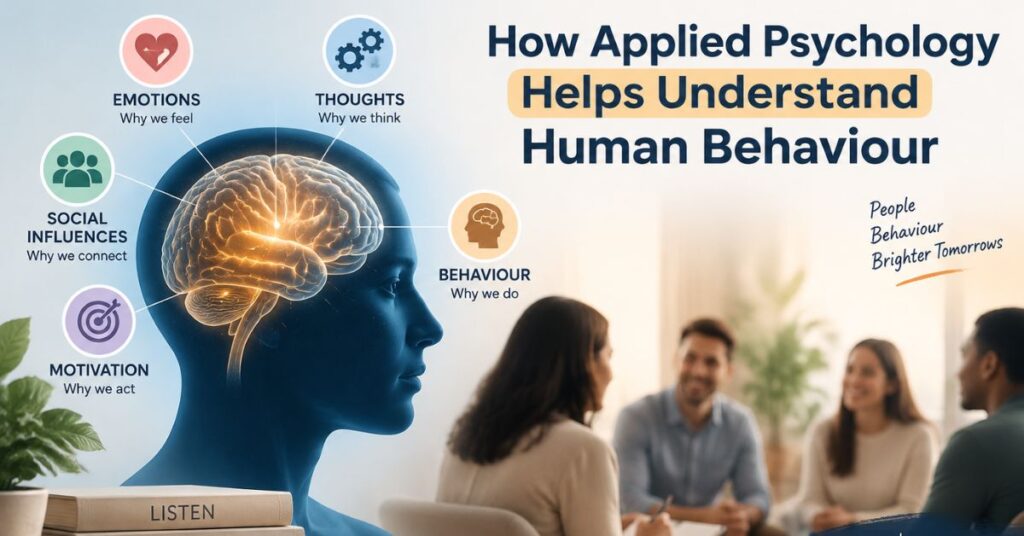
Human behaviour is influenced by many factors, including thoughts, emotions, experiences, relationships, environment, and social conditions. Understanding why people think, feel, and act in particular ways can help improve communication, decision-making, relationships, education, and workplace interactions. Applied psychology focuses on using psychological knowledge to understand real-life behaviour and address practical challenges. For students interested in developing this knowledge, psychology diploma courses can provide a foundation in psychological concepts and their practical applications.
Unlike studying behaviour only from a theoretical perspective, applied psychology connects psychological principles with everyday situations. It helps professionals understand patterns in human behaviour and develop practical approaches that can support individuals and communities.
Understanding Thoughts and Emotions
One of the important contributions of applied psychology is helping people understand the connection between thoughts, emotions, and behaviour. A person’s interpretation of an event can influence how they feel and respond to it.
For example, two people may experience the same situation but react differently because they have different beliefs, experiences, or expectations. Applied psychology examines these differences to understand the factors that influence individual responses.
This knowledge can help professionals identify behavioural patterns and understand why certain situations may lead to particular emotional or behavioural reactions.
Exploring the Influence of Environment
Human behaviour does not develop in isolation. Family relationships, education, workplace conditions, culture, social groups, and surrounding environments can influence how people behave.
Applied psychology considers these environmental influences when examining behaviour. For instance, a person’s performance at work may be affected not only by their skills but also by workplace communication, leadership, workload, recognition, and relationships with colleagues.
Understanding environmental influences allows organisations, educators, and other professionals to create conditions that encourage positive behaviour and better interactions.
Improving Communication and Relationships
Communication plays a major role in personal and professional relationships. Applied psychology helps explain why people may interpret the same message differently and how emotions can affect communication.
Psychological principles can be used to improve listening, empathy, conflict management, and interpersonal communication. Understanding another person’s perspective can reduce misunderstandings and make conversations more productive.
In workplaces, these principles can support better teamwork and leadership. In educational and community settings, they can help professionals communicate more effectively with different groups of people.
Understanding Behaviour in the Workplace
Applied psychology has an important role in understanding behaviour within organisations. Employees have different motivations, personalities, expectations, and working styles. Recognising these differences can help organisations develop healthier and more productive work environments.
Psychological approaches can be applied to areas such as employee motivation, leadership, team development, job satisfaction, workplace communication, and organisational change.
For example, understanding what motivates employees can help managers create meaningful recognition and development opportunities rather than relying on the same approach for everyone. This can contribute to stronger engagement and improved workplace relationships.
Supporting Learning and Education
Education is another area where applied psychology can provide valuable insights into human behaviour. Students differ in their learning styles, interests, motivation, attention, confidence, and previous experiences.
Psychological knowledge can help educators understand these differences and create learning environments that encourage participation and development. It can also help identify factors that may affect concentration, motivation, and academic performance.
Rather than viewing every learning challenge in the same way, applied psychology encourages professionals to consider the individual and the environment surrounding the learner.
Understanding Decision-Making
People make decisions every day, from simple choices to important life decisions. These decisions are influenced by emotions, previous experiences, social pressure, expectations, available information, and personal beliefs.
Applied psychology examines these influences to better understand how people evaluate choices and respond to situations. This can be useful in areas such as business, education, healthcare, consumer behaviour, and public services.
Understanding decision-making can also help professionals design clearer communication and provide information in ways that support more informed choices.
Recognising Individual Differences
No two people respond to every situation in exactly the same way. Personality, background, experiences, values, abilities, and social environments can all contribute to individual differences.
Applied psychology helps professionals recognise these variations instead of assuming that one approach will work for everyone. This individual-focused perspective can lead to more appropriate strategies for communication, learning, workplace development, and behavioural support.
Recognising individual differences is particularly important when working with diverse groups because it encourages professionals to consider the unique circumstances of each person.
Applying Psychology to Everyday Life
The value of applied psychology extends beyond professional settings. Its principles can help people become more aware of their own behaviour and better understand those around them.
For example, recognising emotional triggers can encourage more thoughtful responses during difficult situations. Understanding communication patterns can improve relationships, while awareness of social influences can help people evaluate their decisions more carefully.
This practical understanding can encourage self-awareness, empathy, adaptability, and healthier interactions.
Conclusion
Applied psychology provides a practical way to understand the complex factors behind human behaviour. By examining thoughts, emotions, experiences, social influences, and environmental conditions, it helps explain why people respond differently to similar situations. Courses on mental health online can also help learners develop a deeper understanding of psychological concepts and their practical applications.
Its applications can be seen across education, workplaces, relationships, communication, decision-making, and community settings. As human behaviour continues to be influenced by changing social and technological environments, applied psychology remains valuable for developing practical approaches to real-world challenges.
Understanding behaviour is not simply about predicting what people will do. It is about recognising the factors that shape behaviour and using that knowledge to create more effective, supportive, and human-centred solutions.